How Many Amps Does a Hair Dryer Use?
A typical hair dryer uses between 8 and 15 amps, depending on its wattage and settings. Most standard models pull around 10 to 12 amps at full power, with wattage ranging from 1,000 to 1,875 watts. This variation means the amps your hair dryer uses can change based on how hot or fast you set it.
For example, a 1,500-watt dryer draws about 12.5 amps on a 120-volt circuit. Knowing this helps you avoid overloading circuits and manage energy costs. It’s pretty helpful to understand these numbers if you want to keep your electrical system safe and save on your electricity bill. Keep going to learn how to calculate amps and reduce your dryer’s power use.
Key Takeaways
- Most hair dryers draw between 8 to 15 amps depending on wattage and power settings.
- Typical household hair dryers operate around 10 to 12 amps at full power.
- Amps can be calculated by dividing the dryer’s wattage by the voltage (amps = watts ÷ 120 volts).
- A 1,500-watt hair dryer usually pulls about 12.5 amps on a standard 120-volt circuit.
- High amp draw may overload circuits, so avoid using multiple high-amp devices on the same outlet.
You don’t want to accidentally trip your breaker by plugging in too many things at once. Just keep an eye on how much power your devices are pulling!
How Many Amps Does a Typical Hair Dryer Use?

When you turn on a typical hair dryer, it usually draws between 8 to 15 amps depending on its power settings and design. Most standard models operate around 10 to 12 amps at full power.
If you lower the heat or speed setting, the amperage decreases accordingly. The exact current draw depends on wattage, which commonly ranges between 1,200 and 1,875 watts for household hair dryers.
Since amperage equals wattage divided by voltage (usually 120 volts in the U.S.), you can estimate the amps by dividing the dryer’s wattage by 120. For example, a 1,500-watt dryer will pull about 12.5 amps.
Understanding this helps you gauge how much electrical load your hair dryer adds when in use, letting you plan accordingly for your household’s electrical capacity.
How Hair Dryer Amps Affect Home Electrical Safety

Knowing how many amps your hair dryer uses helps you understand the impact it has on your home’s electrical system. If your hair dryer draws too much current, it can overload circuits, potentially causing breakers to trip or even leading to electrical fires.
Understanding your hair dryer’s amp usage helps prevent circuit overloads and electrical hazards at home.
You want to avoid plugging high-amp devices into outlets already near their capacity. Using a hair dryer with a high amp draw on an outdated or weak circuit increases risk.
Also, if multiple high-amp appliances run simultaneously on the same circuit, it can strain wiring and components. By being aware of your hair dryer’s amp usage, you can make sure you don’t exceed your home’s electrical limits.
That way, you’ll keep your family and property safe from electrical hazards. It’s all about staying informed and cautious.
How to Calculate Your Hair Dryer’s Amp Draw
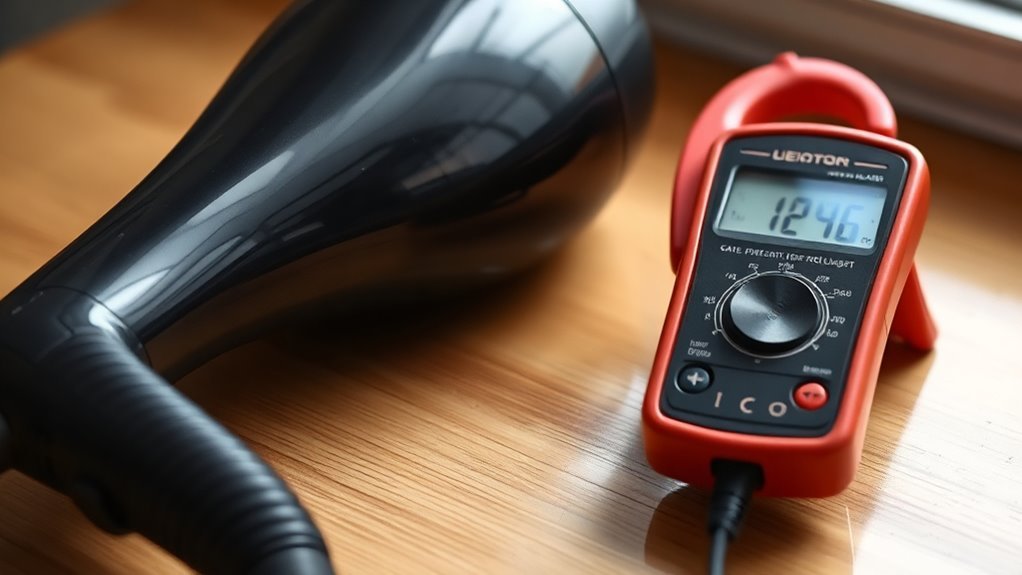
To calculate your hair dryer’s amp draw, start by finding its wattage, usually listed on the label. Next, use the voltage of your power source—typically 120 volts in the U.S.—to perform the calculation.
Applying Ohm’s Law, you can determine the amps by dividing the wattage by the voltage. It’s pretty straightforward once you have those numbers. Give it a try!
Find Hair Dryer Wattage
Your hair dryer’s wattage provides the key to figuring out its amp draw. To find this number, start by checking the label on the dryer itself—usually on the handle or near the cord. The wattage is often listed as “Power” or just “W.”
If you can’t find the label, check the user manual or the manufacturer’s website. Knowing the wattage is essential because it tells you how much electrical power the dryer uses.
Once you have this value, you can move on to calculating the amps it draws from your outlet. Remember, wattage reflects the energy consumption under normal operating conditions, so use the exact number listed to get an accurate estimate of the current your hair dryer pulls.
Use Voltage To Calculate
Once you have the wattage of your hair dryer, you can calculate how many amps it draws by using the voltage of your electrical outlet. Most household outlets in the U.S. supply 120 volts, while some areas or special outlets provide 240 volts.
To find the amp draw, simply divide the wattage by the outlet voltage. For example, if your hair dryer uses 1800 watts and your outlet provides 120 volts, divide 1800 by 120, which equals 15 amps.
This tells you your hair dryer pulls 15 amps when in use. Knowing this helps you understand the electrical load and guarantees your circuit can handle the device safely without tripping breakers or causing hazards.
Apply Ohm’s Law
Although calculating amps using voltage and wattage is straightforward, applying Ohm’s Law gives you another way to determine your hair dryer’s current draw by relating voltage, current, and resistance.
Ohm’s Law states that Current (I) equals Voltage (V) divided by Resistance (R): I = V / R. If you know your hair dryer’s resistance and voltage, you can find the amps it uses.
Here’s a quick reference:
| Voltage (V) | Resistance (Ω) |
|---|---|
| 120 | 12 |
| 120 | 15 |
| 240 | 30 |
| 240 | 24 |
| 120 | 10 |
Just use the formula to plug in values and calculate the current draw accurately. It’s pretty simple once you get the hang of it!
How Hair Dryer Amps and Wattage Impact Electricity Costs
When you use a hair dryer, its amps and wattage directly affect how much electricity you consume—and ultimately, your utility bill. The higher the wattage, the more power the dryer draws, increasing electricity use.
For example, a 1500-watt dryer running for 10 minutes consumes 0.25 kilowatt-hours (kWh) of energy. Your utility company charges based on kWh, so longer or more frequent use ramps up costs.
Amps indicate the current flow, which relates to wattage and voltage, helping you understand power demands. Knowing your hair dryer’s wattage helps you estimate its impact on your monthly bill more accurately.
Tips to Reduce Your Hair Dryer’s Amp Draw
To cut down your hair dryer’s amp draw, start by choosing lower heat and speed settings whenever possible. Avoid using the highest heat for long periods, as this markedly increases power consumption.
Also, limit drying time by towel-drying your hair first. Keeping the dryer’s filter clean improves airflow, letting it work more efficiently and reducing amperage.
Finally, use cool air settings to finish drying; they consume less electricity and protect your hair.
| Tip | Why It Helps | How to Do It |
|---|---|---|
| Use lower heat/speed | Reduces power demand | Set to medium or low settings |
| Towel dry hair first | Shortens dryer usage time | Pat hair dry before blow drying |
| Clean dryer filter | Improves airflow | Remove lint regularly |
| Use cool air setting | Uses less electricity | Switch to cool air to finish |
What to Look for When Choosing a Low-Amp Hair Dryer
When choosing a low-amp hair dryer, start by understanding the relationship between wattage and amps to find an energy-efficient model. You’ll want one that uses less power without sacrificing performance.
Also, consider a compact design for easier handling and quicker drying times. It just makes the whole process smoother and way more convenient.
Wattage And Amp Relationship
Understanding the wattage and amp relationship can help you pick a hair dryer that won’t overload your electrical circuit. Watts measure the power the dryer uses, while amps indicate how much electrical current it draws.
You can find amps by dividing the wattage by your home’s voltage (typically 120 volts in the U.S.). For example, a 1200-watt dryer uses about 10 amps (1200 ÷ 120 = 10). If your circuit can’t handle that, the breaker trips.
So when choosing a low-amp hair dryer, look for models with lower wattage or dual voltage options. This way, you reduce the current draw and avoid electrical issues while still getting effective drying power.
Keep this relationship in mind to make a smart, safe choice. It’s a simple step that can save you from headaches down the line.
Energy Efficiency Importance
Although low-amp hair dryers reduce electrical load, choosing one with strong energy efficiency guarantees you save both power and money over time.
When picking a low-amp model, focus on these key factors:
- Wattage Rating: Look for dryers with lower wattage but effective heat output. This way, you use less energy without sacrificing performance.
- Heat and Speed Settings: Multiple adjustable settings let you use only the power you need. That helps prevent wasteful energy use.
- Technology Features: Ionic or ceramic technology often improves drying efficiency. This cuts down the time and energy needed.
Compact Design Benefits
Choosing a compact hair dryer can make a big difference in convenience and efficiency. When you pick a smaller model, it’s easier to handle, store, and travel with.
Compact designs tend to use less power, which means lower amps and reduced energy consumption. You’ll want to look for a dryer that balances size with performance, ensuring it still delivers enough heat and airflow without drawing excessive current.
Features like foldable handles and lightweight materials add to portability without sacrificing functionality. Plus, compact dryers often heat up quickly, saving you time.
Frequently Asked Questions
Can Using a Hair Dryer Cause Electrical Fires?
Yes, using a hair dryer can cause electrical fires if it overheats, has damaged cords, or is plugged into faulty outlets. You should always inspect it regularly and avoid leaving it unattended while in use.
It’s really important to keep an eye on your hair dryer. If you notice any frayed wires or if it’s getting too hot, don’t ignore it. Safety first!
Are Hair Dryers Safe to Use in Bathrooms?
You shouldn’t use hair dryers in bathrooms without a GFCI outlet—they prevent shocks like a knight’s armor shields him.
Always keep your dryer dry and away from water to stay safe while styling in such a damp environment.
How Often Should I Replace My Hair Dryer?
You should replace your hair dryer every 3 to 5 years, or sooner if it shows signs of damage, overheating, or unusual noise.
It’s a good idea to check its condition regularly. That way, you stay safe and make sure it works efficiently.
Do Professional Hair Dryers Use More Amps?
Yes, professional hair dryers usually use more amps because they have higher wattage for faster drying. You’ll notice they draw more power, but that means better performance and durability for frequent, heavy use.
Basically, they’re built to handle more intense use without burning out. So, if you’re styling a lot or need quick results, the extra amps are worth it.
Can a Hair Dryer Damage My Hair?
You can damage your hair if you blast it with intense heat, drying it out like a desert under the sun.
To protect your strands, use cooler settings and keep the dryer moving steadily. This way, you won’t fry your hair and it stays healthy.
Conclusion
Knowing how many amps your hair dryer uses is like having a map for your home’s electrical journey—it helps you avoid overloads and keeps your power running smoothly. Understanding the amp draw of your device gives you a clearer picture of how much electricity it pulls from your outlets.
By choosing energy-efficient models, you can protect your home’s electrical system and also save on electricity costs. It’s a smart move that benefits both your wallet and your wiring.
So, take charge wisely when it comes to your hair dryer’s amperage. With the right knowledge, your hair dryer won’t just be a tool—it’ll be a reliable part of your daily routine without risking an electrical storm. Knowing the amps used helps you stay safe and efficient.